Introduction
Text structure means the way ideas, details, and information are arranged in a piece of writing. Imagine reading a story where the events appear in a confusing order.
You may understand each sentence, but the whole text feels hard to follow. Good text structure prevents this problem by giving writing a clear shape and flow.
The term is commonly used in schools, essays, books, articles, and academic writing.
Learning synonyms for text structure helps English learners understand different ways to describe how writing is organized.
It also helps content writers avoid repeating the same phrase too often.
In this article, we will explore the meaning of text structure, useful synonyms, examples, grammar, word history, pronunciation, word formation, and semantic categories.
These alternatives can help you describe writing more clearly and naturally.
Meaning of Text Structure
Definition
Text structure (Noun Phrase): The way ideas, information, sentences, and sections are organized within a text.
Examples
- The text structure makes the article easy to follow
- The teacher asked students to identify the text structure of the passage
Connotative Meaning
Connotation: The feeling or idea that a word suggests beyond its basic meaning
- Positive tone: Text structure can suggest clarity, order, logic, and good organization
- Negative tone: Poor text structure can suggest confusion, disorder, or weak organization
- Neutral tone: Text structure can simply describe how information is arranged
Etymology
The phrase text structure combines two words with Latin roots.
Text comes from Latin textus, meaning “woven” or “something woven,” while structure comes from Latin structura, meaning “a building” or “arrangement.”
- Old English (450–1100): The modern phrase text structure was not used in Old English, but English developed words related to writing, arranging, building, and ordering
- Middle English (1100–1500): Words related to text and structure entered English through Latin and French influence and developed meanings connected with written works and arrangement
- Modern English (1500–Present): Text came to mean a written work or passage, while structure developed its modern sense of the way parts are arranged.
The phrase text structure became common in education, literacy studies, linguistics, and writing instruction
Pronunciation (IPA)
- IPA: /tɛkst ˈstrʌktʃər/
- Syllables: text struc-ture
Affixation Pattern of Text Structure
- Root: text and struct
- Prefix: None in the complete phrase
- Suffix: -ure in structure
- Word formations:
- text — noun
- textual — adjective
- textually — adverb
- structure — noun
- structured — adjective/past participle
- structural — adjective
- structurally — adverb
- restructure — verb
- restructured — adjective/past participle
- structuring — noun/verb form
- structuralism — noun
- structuralist — noun/adjective
30 Synonyms of Text Structure With Meaning & Examples
1. Organization (Noun)
Meaning: The way parts or ideas are arranged in a clear order
Examples:
- The organization of the essay is easy to understand
- Good organization helps readers follow the writer’s ideas
2. Arrangement (Noun)
Meaning: The way different parts are placed or ordered
Examples:
- The arrangement of the paragraphs creates a smooth flow
- The writer changed the arrangement of the information
3. Structure (Noun)
Meaning: The way the parts of something are connected and organized
Examples:
- The structure of the essay is very clear
- Students learned how to improve their paragraph structure
4. Format (Noun)
Meaning: The particular way information is presented or organized
Examples:
- The article uses a simple format
- This format makes the information easier to read
5. Framework (Noun)
Meaning: A basic system that supports and organizes ideas
Examples:
- The writer created a framework for the report
- This framework helps organize the main arguments
6. Composition (Noun)
Meaning: The way parts are combined to create a complete piece of writing
Examples:
- The composition of the essay is carefully planned
- Good composition gives the article a natural flow
7. Organization Pattern (Noun Phrase)
Meaning: A particular method used to arrange information in a text
Examples:
- The passage follows a chronological organization pattern
- Students identified the organization pattern of the article
8. Text Organization (Noun Phrase)
Meaning: The way information and ideas are ordered within a text
Examples:
- Text organization affects how easily readers understand an article
- The teacher explained several types of text organization
9. Discourse Structure (Noun Phrase)
Meaning: The way ideas and sections are connected across spoken or written communication
Examples:
- The study examines discourse structure in academic writing
- Discourse structure helps connect ideas across a passage
10. Rhetorical Structure (Noun Phrase)
Meaning: The way a writer arranges ideas to achieve a communication purpose
Examples:
- The rhetorical structure supports the writer’s argument
- Students studied the rhetorical structure of the speech
11. Layout (Noun)
Meaning: The way written or visual elements are placed on a page
Examples:
- The layout of the article is clean and simple
- A clear layout makes the text easier to scan
12. Pattern (Noun)
Meaning: A repeated or recognizable way of organizing information
Examples:
- The writer uses a cause-and-effect pattern
- The pattern of the passage becomes clear after the introduction
13. Organization Scheme (Noun Phrase)
Meaning: A planned method for arranging information
Examples:
- The writer chose a logical organization scheme
- The organization scheme makes the argument easier to follow
14. Structural Pattern (Noun Phrase)
Meaning: A particular form used to arrange parts of a text
Examples:
- The passage follows a problem-solution structural pattern
- Students identified the structural pattern of the story
15. Textual Organization (Noun Phrase)
Meaning: The arrangement of language and ideas within a written text
Examples:
- Textual organization improves the flow of an essay
- The researcher analyzed textual organization in student writing
16. Logical Order (Noun Phrase)
Meaning: An arrangement in which ideas follow a sensible sequence
Examples:
- The essay presents its points in logical order
- Logical order helps readers understand complex information
17. Sequence (Noun)
Meaning: The order in which events, ideas, or information appear
Examples:
- The sequence of events is easy to follow
- The writer changed the sequence to improve the story
18. Progression (Noun)
Meaning: The way ideas develop and move forward through a text
Examples:
- The progression of ideas is smooth
- Strong progression keeps the reader interested
19. Flow (Noun)
Meaning: The smooth movement of ideas from one part of a text to another
Examples:
- The article has a natural flow
- Better transitions improved the flow of the essay
20. Development (Noun)
Meaning: The way an idea or topic is expanded through a text
Examples:
- The development of the main idea is clear
- The paragraph needs stronger development
21. Outline (Noun)
Meaning: A plan showing the main parts and ideas of a text
Examples:
- The student created an outline before writing
- The outline gave the essay a clear structure
22. Blueprint (Noun)
Meaning: A detailed plan for creating or organizing something
Examples:
- The outline acted as a blueprint for the article
- A good blueprint can guide the writing process
23. Architecture (Noun)
Meaning: The overall design and organization of a complex text
Examples:
- The architecture of the report is easy to understand
- The writer carefully planned the article’s architecture
24. Design (Noun)
Meaning: The planned arrangement of parts for a particular purpose
Examples:
- The design of the essay supports its main message
- The writer improved the design of the document
25. Construction (Noun)
Meaning: The way a written work is built from different parts
Examples:
- The construction of the argument is strong
- The teacher discussed the construction of the paragraph
26. Formation (Noun)
Meaning: The process or way something is formed or developed
Examples:
- The formation of the text follows a clear pattern
- Sentence formation affects the overall structure
27. Ordering (Noun)
Meaning: The act of putting information into a particular sequence
Examples:
- The ordering of ideas improves clarity
- Careful ordering makes the paragraph easier to understand
28. Presentation (Noun)
Meaning: The way information is shown or communicated to readers
Examples:
- The presentation of information is clear
- Better presentation can make a complex text easier to read
29. Textual Framework (Noun Phrase)
Meaning: The basic organizational system that holds the ideas of a text together
Examples:
- The textual framework supports the main argument
- A strong textual framework gives the essay direction
30. Disposition (Noun)
Meaning: The particular arrangement or placement of parts
Examples:
- The disposition of the ideas creates a clear argument
- The writer changed the disposition of the sections
Prototype Meaning
The most typical meaning of text structure is the organized arrangement of ideas and information in writing.
When people hear this term, they usually imagine how an essay, story, article, or passage is divided into parts and how those parts connect.
A common example is an essay with an introduction, body paragraphs, and conclusion.
Text structure helps readers understand what comes first, what follows, and how the main ideas relate to each other.
Prototype Categorization
The 30 synonyms can be grouped into several semantic categories. This helps writers choose a word that matches the exact meaning they want.
- General organization: organization, arrangement, structure, format, composition describe the broad way a text is put together
- Planning and support: framework, outline, blueprint, textual framework describe plans or systems that guide writing
- Patterns and order: organization pattern, pattern, structural pattern, sequence, logical order, ordering focus on how information is placed in a particular order
- Academic and linguistic terms: discourse structure, rhetorical structure, text organization, textual organization are useful in academic, linguistic, and educational contexts
- Movement of ideas: progression, flow, development describe how ideas move, connect, and grow throughout a text
- Design and presentation: layout, architecture, design, presentation focus on the overall design or visible arrangement of information
- Building and formation: construction, formation, disposition describe how different parts are formed or positioned
Choosing the right synonym depends on context. For example, layout works well for page design, while discourse structure is more suitable for academic language analysis.
Antonyms of Text Structure
- Disorganization (Noun): A lack of clear order among ideas or parts
- Disorder (Noun): A state in which elements are arranged without a clear system
- Confusion (Noun): A lack of clarity or logical connection
- Chaos (Noun): Complete lack of order or organization
- Fragmentation (Noun): A condition in which a text is divided into disconnected parts
- Incoherence (Noun): Lack of logical connection between ideas
- Randomness (Noun): Arrangement without a clear plan or pattern
- Disjointedness (Noun): A condition in which parts do not connect smoothly
Short Questions and Answers
What does text structure mean?
Text structure means the way ideas, information, and parts of a written text are organized and connected.
When should text structure be used?
Use text structure when discussing how a passage, essay, article, or other text is organized.
Is text structure positive or negative?
It is neutral by itself. A clear text structure can suggest good organization, while a poor structure can make writing difficult to understand.
How is it different from similar words?
Text structure specifically focuses on how a text is organized. Words such as layout focus more on visual arrangement, while flow focuses on the movement of ideas.
Why are synonyms for text structure useful?
They help writers describe organization more precisely and avoid repeating the same expression.
What is another word for text structure?
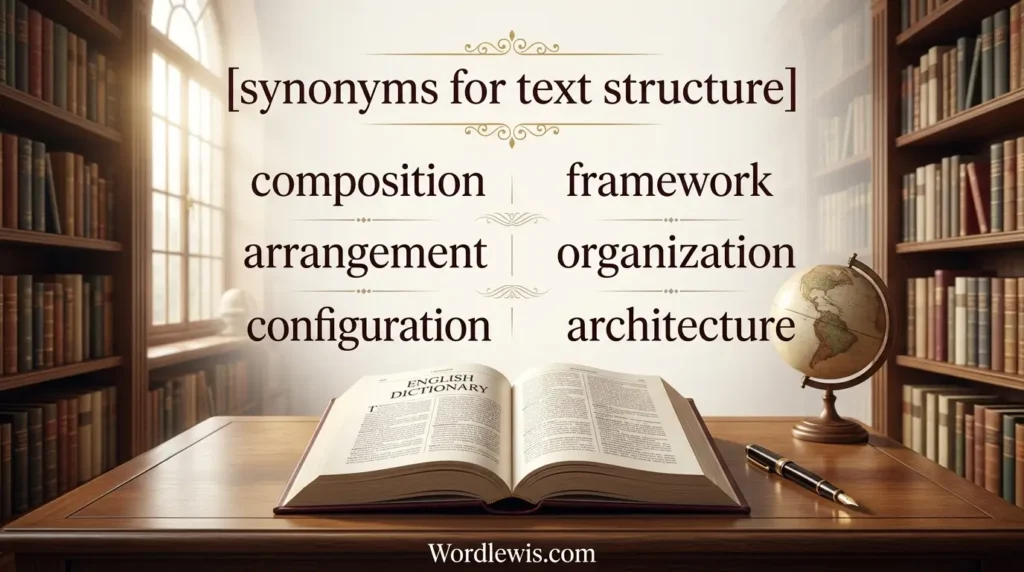
Depending on the context, useful alternatives include text organization, structure, framework, arrangement, organization, and rhetorical structure.
Conclusion
Learning text structure and its synonyms can make English writing clearer and more flexible.
Words such as organization, arrangement, framework, sequence, and textual organization help writers describe different parts of writing with greater accuracy.
These alternatives also reduce repetition and make essays, articles, reports, and academic work more natural.
English learners can use them to understand how ideas are connected and presented in different texts.
Content writers can use them to explain writing techniques without using the same phrase again and again.
The best synonym depends on the context and the exact meaning you want to express.
Practicing a few new words each day is a simple way to build vocabulary, strengthen speaking and writing skills, and gain confidence in English.

welcome to Words Mints! I’m Halay Sultan, a web developer and AI-Powered SEO content writer.