
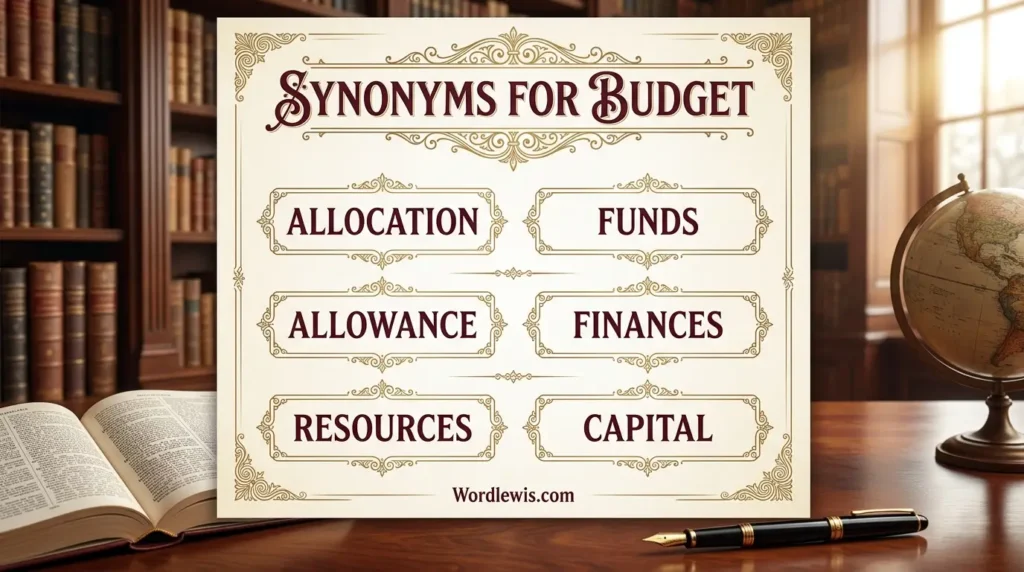
A budget is a plan for how to spend and save money. For example, a family may set a budget to pay bills, buy food, and save for a trip.
A student may also follow a budget to manage daily costs. The word budget is common in homes, schools, businesses, and government. It helps people plan their money and avoid extra costs.
Learning synonyms for budget can help English learners build a stronger vocabulary. It also helps writers explain money plans in clear and simple ways.
However, not every synonym has the same meaning. Some words refer to a spending plan, while others describe a limit, an amount of money, or a low-cost choice.
This guide explains the meaning of budget, its history, pronunciation, grammar, and 30 useful synonyms.
You will also learn how to use these words in sentences and choose the right word for each situation.
Meaning of Budget
Definition
Budget (Noun/Verb):
As a noun, a budget is a plan that shows how much money a person or group expects to earn and spend. As a verb, budget means to plan how to use money or other resources.
Examples
- Our family made a budget for the next month.
- We need to budget our money carefully.
Connotative Meaning
(Connotation: the feeling or idea that a word suggests beyond its basic meaning.)
- Positive tone: A budget can suggest careful planning, savings, control, and financial success.
- Negative tone: It can suggest limits, financial stress, or a lack of money.
- Neutral tone: It can simply mean a plan for income and spending.
Etymology
The word budget came into English through French. Its history is linked to a small bag used to carry money or documents.
- Old English (450–1100): The word budget was not part of common Old English vocabulary. English used other words for bags, purses, and money.
- Middle English (1100–1500): The word entered English through Anglo-French and Middle French forms related to a small bag or pouch. Its use developed during the late Middle English period.
- Modern English (1500–Present): The word became associated with a bag of financial documents and later with a plan of income and spending. Today, it is widely used in personal finance, business, and government.
Pronunciation (IPA)
- IPA: /ˈbʌdʒɪt/
- Syllables: bud-get (2 syllables)
Affixation Pattern of Budget
- Root: budget
- Prefix: None in the basic word.
- Suffix: None in the basic word.
Word Formations
- Budget (noun): A plan for income and spending.
- Budget (verb): To plan the use of money.
- Budgeted (verb, past tense): Planned how money would be used.
- Budgeting (noun/verb): The act of planning income and spending.
- Budgeter (noun): A person who makes or follows a budget.
- Budgetary (adjective): Related to a budget.
- Budget-friendly (adjective): Affordable or suitable for a limited amount of money.
- Overbudget (adjective/adverb): Above the planned spending amount.
- Underbudget (adjective/adverb): Below the planned spending amount.
30 Synonyms of Budget With Meaning & Examples
The best synonym depends on the context. Some words below mean a spending plan, while others refer to available funds, spending limits, or low-cost options.
1. Financial Plan (Noun)
Meaning: A plan for managing income, spending, savings, and other financial goals.
Examples:
- We created a financial plan for the year.
- Her financial plan includes money for rent and savings.
2. Spending Plan (Noun)
Meaning: A plan that shows how money will be spent.
Examples:
- The family made a spending plan for the month.
- Our spending plan helps us avoid waste.
3. Allocation (Noun)
Meaning: The amount of money or resources assigned to a particular purpose.
Examples:
- The school increased its allocation for books.
- Each department received an allocation for new equipment.
4. Allowance (Noun)
Meaning: An amount of money set aside or given for a specific purpose.
Examples:
- My weekly allowance covers small expenses.
- The project has a travel allowance of $500.
5. Expenditure Plan (Noun)
Meaning: A plan that explains how money will be spent.
Examples:
- The city approved an expenditure plan.
- Our expenditure plan includes repairs and supplies.
6. Financial Framework (Noun)
Meaning: A structure used to guide financial decisions and spending.
Examples:
- The company developed a financial framework for growth.
- A clear financial framework helps the team plan ahead.
7. Spending Limit (Noun)
Meaning: The highest amount of money that can be spent.
Examples:
- We set a spending limit for our holiday.
- The manager approved a spending limit of $2,000.
8. Expense Plan (Noun)
Meaning: A plan for expected costs and expenses.
Examples:
- The event needs an expense plan.
- We reviewed the expense plan before booking the venue.
9. Financial Estimate (Noun)
Meaning: An informed calculation of expected costs or income.
Examples:
- The contractor gave us a financial estimate.
- Our financial estimate shows the project may cost more.
10. Cost Plan (Noun)
Meaning: A plan that sets out expected costs for a task or project.
Examples:
- The builder prepared a cost plan for the house.
- We checked the cost plan before starting work.
11. Funds (Noun)
Meaning: Money available for a particular use.
Examples:
- The school needs more funds for repairs.
- We saved enough funds for the trip.
12. Financing (Noun)
Meaning: The money or method used to pay for something.
Examples:
- The project needs extra financing.
- We found financing for the new office.
13. Resources (Noun)
Meaning: Money, materials, or other things available for use.
Examples:
- The team used its resources wisely.
- We have limited resources for this project.
14. Appropriation (Noun)
Meaning: Money officially set aside for a specific purpose, often by a government or organization.
Examples:
- The council approved an appropriation for road repairs.
- The school received an appropriation for new computers.
15. Grant (Noun)
Meaning: Money given for a specific purpose, often by a government or organization, that usually does not need to be repaid.
Examples:
- The school received a grant for new books.
- She used the grant to support her research.
16. Quota (Noun)
Meaning: A fixed share or amount assigned to a person or group.
Examples:
- Each department received a quota for its spending.
- The team must stay within its monthly quota.
17. Cap (Noun)
Meaning: A limit on the amount that can be spent or used.
Examples:
- The company placed a cap on travel costs.
- We set a cap of $300 for decorations.
18. Ceiling (Noun)
Meaning: The maximum permitted amount of spending, cost, or funding.
Examples:
- The project has a spending ceiling of $10,000.
- The board set a ceiling on staff travel expenses.
19. Provision (Noun)
Meaning: An amount of money or resources set aside for a particular need.
Examples:
- The plan includes a provision for repairs.
- We made a provision for unexpected costs.
20. Reserve (Noun)
Meaning: Money kept for future needs or emergencies.
Examples:
- The family built a reserve for emergencies.
- The company used its reserve to cover repairs.
21. Outlay (Noun)
Meaning: The amount of money spent on something.
Examples:
- The initial outlay for the shop was high.
- We reduced our outlay by buying used furniture.
22. Cost Estimate (Noun)
Meaning: An approximate calculation of how much something will cost.
Examples:
- The mechanic gave us a cost estimate.
- We used the cost estimate to plan our spending.
23. Projection (Noun)
Meaning: An estimate of future income, costs, or financial results.
Examples:
- The company prepared a projection for next year.
- Our sales projection helped us plan future costs.
24. Forecast (Noun)
Meaning: An estimate of future financial conditions, income, or spending.
Examples:
- The financial forecast predicts higher costs.
- We updated our forecast after reviewing sales.
25. Ledger (Noun)
Meaning: A record of financial transactions, income, and expenses.
Examples:
- She entered each expense in the ledger.
- The bookkeeper checked the ledger at the end of the month.
26. Accounts (Noun)
Meaning: Financial records that show money received, owed, or spent.
Examples:
- The accountant reviewed the company’s accounts.
- We checked our accounts before planning new purchases.
27. Financial Statement (Noun)
Meaning: A report that shows financial information, such as income, expenses, assets, and debts.
Examples:
- The manager reviewed the financial statement.
- The financial statement showed a rise in costs.
28. Shoestring Budget (Noun)
Meaning: A very small amount of money available for spending.
Examples:
- They launched the project on a shoestring budget.
- We planned a fun party on a shoestring budget.
29. Spending Allowance (Noun)
Meaning: An amount of money permitted for a particular type of spending.
Examples:
- The team received a spending allowance for supplies.
- My spending allowance covers meals during the trip.
30. Financial Provision (Noun)
Meaning: Money planned or set aside to meet a future need or cost.
Examples:
- The company made a financial provision for repairs.
- Our financial provision covers possible emergency expenses.
Prototype Meaning
The most typical meaning of budget is a plan for managing money. When people hear this word, they often imagine a list of income, bills, shopping costs, savings, and other expenses.
A budget helps people decide how much money they can spend and how much they should save.
Families use budgets to manage household costs, businesses use them to control spending, and governments use them to plan public funds.
The word can also describe a spending limit or a low-cost option, as in budget travel or budget hotel. The exact meaning depends on the sentence.
Prototype Categorization
The 30 synonyms can be grouped by meaning. This helps writers choose a word that fits the situation instead of replacing budget with a word that has a different meaning.
- Planning and organization: Financial plan, spending plan, expenditure plan, financial framework, expense plan, and cost plan. These words describe ways to organize money and expected costs.
- Assigned money and resources: Allocation, allowance, funds, financing, resources, appropriation, grant, provision, and financial provision. These words focus on money or resources made available for a purpose.
- Limits and fixed amounts: Spending limit, quota, cap, ceiling, and spending allowance. These terms are useful when discussing the maximum amount someone can spend or use.
- Costs and estimates: Financial estimate, outlay, cost estimate, projection, and forecast. These words describe expected costs, actual spending, or future financial results.
- Records and reports: Ledger, accounts, and financial statement. These terms refer to financial information rather than a spending plan itself.
- Savings and low-cost spending: Reserve and shoestring budget. These terms relate to money saved for future needs or a plan that uses very little money.
Choosing the right category makes writing clearer.
For example, use spending limit for a maximum amount, financial forecast for expected future costs, and financial plan for a broad strategy. Remember that these words are related to budget, but they are not interchangeable in every sentence.
Antonyms of Budget
There is no single exact antonym for budget because it can mean both a financial plan and the act of planning spending.
The following words express contrasting ideas in suitable contexts.
1. Overspending (Noun)
Meaning: Spending more money than planned or than one can afford.
2. Extravagance (Noun)
Meaning: The use of too much money on costly or unnecessary things.
3. Wastefulness (Noun)
Meaning: The careless use of money or other resources.
4. Financial Excess (Noun)
Meaning: Spending or using more money than is needed or allowed.
5. Uncontrolled Spending (Noun)
Meaning: Spending money without careful planning or limits.
6. Deficit (Noun)
Meaning: A situation in which spending or financial needs exceed available income or funds.
7. Recklessness (Noun)
Meaning: A lack of care when making decisions, including financial decisions.
Short Questions and Answers
What does budget mean?
A budget is a plan that shows how much money a person or group expects to receive and spend. It can also mean planning how to use money.
When should budget be used?
Use budget when talking about planned income, expenses, savings, or spending limits. It is common in personal finance, business, and government.
Is budget positive or negative?
The word is usually neutral. It can have a positive tone when it suggests careful planning and saving, or a negative tone when it suggests financial limits or hardship.
How is it different from similar words?
A budget is a plan for managing money. Funds are the money available to use, a spending limit is the maximum amount allowed, and a forecast is an estimate of future financial results.
These words are related but have different uses.
Conclusion
Learning the meaning of budget and its synonyms can improve your English vocabulary. It helps you explain money plans, costs, savings, and spending limits in a clear way.
Words such as financial plan, funds, allocation, and spending limit can make your writing more precise.
However, each word has its own meaning, so choose one that fits your message. Using the right words also helps you avoid repetition in essays, reports, emails, and everyday conversations.
You can build your vocabulary by reading simple financial texts, writing example sentences, and using new words in daily life.
Practice a few synonyms each day, and soon you will feel more confident when speaking and writing in English.

welcome to Words Mints! I’m Halay Sultan, a web developer and AI-Powered SEO content writer.