
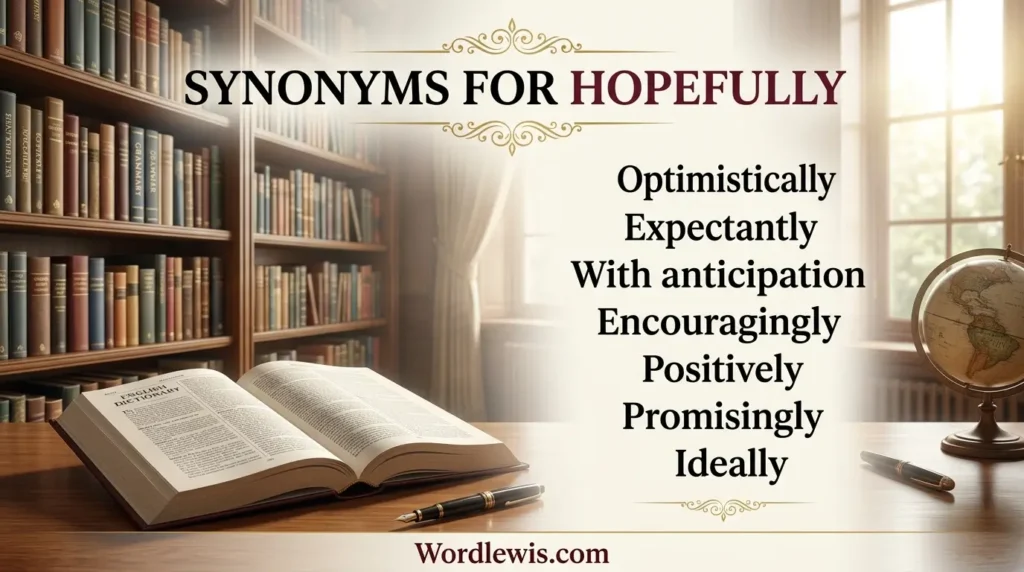
Hopefully is a common English word that helps us express hope, wishes, and positive expectations. Learning its synonyms can make your writing more natural and expressive.
Introduction
Hopefully is an adverb that means in a hopeful way or expressing a wish for something good to happen. Imagine waiting for your exam results.
You might tell a friend, “Hopefully, I passed the exam.” This simple word shows that you want a good result, even though you are not sure what will happen.
People use hopefully in daily conversations, emails, essays, and social media. However, repeating the same word can make writing feel dull.
Learning synonyms for hopefully helps English learners and content writers express hope in different ways.
Some alternatives sound formal, while others fit friendly chats or polite messages.
In this article, you will learn the meaning of hopefully, its history, pronunciation, grammar, and 30 useful synonyms with examples.
We will also explore semantic categories, antonyms, and common questions to help you choose the right word for every situation.
Meaning of Hopefully
Definition
Hopefully (Adverb):
Hopefully means in a hopeful manner or expressing a wish that something good will happen.
It is often used to show that you expect or want a positive result.
Examples
- Hopefully, the weather will be sunny tomorrow
- Hopefully, I will finish my work before dinner
- Hopefully, she gets the job she wants
Connotative Meaning
Connotation: The feeling or emotion that a word suggests beyond its basic meaning.
- Positive tone: Hope, confidence, and a desire for good results
- Negative tone: Usually no negative meaning, but it may suggest worry or uncertainty when a good result is not guaranteed
- Neutral tone: A simple expression of hope without strong emotion
For example, “Hopefully, the meeting goes well” expresses a positive wish while showing that the result is still unknown.
Etymology
The word hopefully comes from the adjective hopeful and the suffix -ly.
- Old English (450–1100): The word hope comes from Old English hopa, meaning expectation or confidence that something desired may happen
- Middle English (1100–1500): The forms hope and hopeful developed as English changed. The suffix -ly was used to form adverbs
- Modern English (1500–Present): Hopefully developed as an adverb meaning “in a hopeful manner.” In modern usage, it is also widely used to express a wish, as in “Hopefully, it will rain”
The sentence adverb meaning of hopefully became common in modern English. This use allows speakers to express hope about an entire situation.
Pronunciation (IPA)
- IPA: /ˈhoʊpfəli/ (American English), /ˈhəʊpfəli/ (British English)
- Syllables: hope-ful-ly
- Stress: First syllable
Affixation Pattern of Hopefully
- Root: hope
- Prefix: None
- Suffix: -ful and -ly
Word Formations
- Hope — Noun / Verb
- Hopeful — Adjective
- Hopefully — Adverb
- Hopefulness — Noun
- Hopeless — Adjective
- Hopelessly — Adverb
- Hopelessness — Noun
The suffix -ful means “full of,” while -ly commonly changes an adjective into an adverb.
30 Synonyms for Hopefully With Meaning & Examples
The best synonym depends on what you mean. Some alternatives express a wish, some show confidence, and others describe a hopeful attitude.
1. Optimistically (Adverb)
Meaning: In a positive way, expecting good results.
Examples:
- She looked optimistically toward the future
- He spoke optimistically about his new business
2. With Hope (Adverbial Phrase)
Meaning: In a way that shows you want something good to happen.
Examples:
- With hope, we waited for the final results
- She looked toward the future with hope
3. In Hope (Adverbial Phrase)
Meaning: While hoping that something will happen.
Examples:
- He applied for the job in hope of a better future
- They traveled abroad in hope of finding work
4. God Willing (Phrase)
Meaning: If circumstances allow or if God permits, something will happen.
Examples:
- God willing, we will meet again soon
- God willing, the project will finish next month
5. All Being Well (Phrase)
Meaning: If everything goes as planned.
Examples:
- All being well, we will arrive before sunset
- All being well, the team will complete the work today
6. If All Goes Well (Phrase)
Meaning: If no problems occur and things work out.
Examples:
- If all goes well, we will move next week
- If all goes well, the event will start on time
7. With Any Luck (Phrase)
Meaning: If good fortune helps the situation.
Examples:
- With any luck, we will catch the early train
- With any luck, the rain will stop soon
8. Fingers Crossed (Idiom)
Meaning: A way to express hope for a good result.
Examples:
- Fingers crossed, I get the scholarship
- Fingers crossed, our team wins tonight
9. Let Us Hope (Phrase)
Meaning: A way to express a shared wish for something good.
Examples:
- Let us hope the patient feels better soon
- Let us hope the weather improves
10. I Hope (Phrase)
Meaning: Used to express a personal wish or expectation.
Examples:
- I hope you have a wonderful day
- I hope everything works out for you
11. Hopefully So (Phrase)
Meaning: Used to agree with or support a hopeful idea.
Examples:
- “Will the package arrive today?” “Hopefully so”
- “Can we finish early?” “Hopefully so”
12. One Hopes (Phrase)
Meaning: A formal or slightly detached way to express hope.
Examples:
- One hopes that the plan succeeds
- One hopes the new policy brings improvement
13. It Is to Be Hoped (Phrase)
Meaning: A formal way to say that something is desired or expected.
Examples:
- It is to be hoped that peace will return
- It is to be hoped that the changes help students
14. With Optimism (Adverbial Phrase)
Meaning: In a way that shows positive expectations.
Examples:
- She approached the challenge with optimism
- He faced the future with optimism
15. Positively (Adverb)
Meaning: In a confident and hopeful way.
Examples:
- The manager spoke positively about the team’s progress
- She thinks positively about her future
16. Confidently (Adverb)
Meaning: In a way that shows strong belief in success.
Examples:
- He confidently expected good results
- She confidently prepared for the competition
17. Expectantly (Adverb)
Meaning: In a way that shows you are waiting for something you expect.
Examples:
- The children waited expectantly for the gifts
- She looked expectantly at the teacher
18. Trustfully (Adverb)
Meaning: In a way that shows trust or belief.
Examples:
- He waited trustfully for his friend’s reply
- She looked trustfully toward her mentor
19. Assuredly (Adverb)
Meaning: Certainly or with confidence.
Examples:
- Assuredly, the hard work will bring results
- She will assuredly improve with practice
20. Surely (Adverb)
Meaning: Used to show strong belief that something will happen.
Examples:
- Surely, things will get better
- Surely, we can find a solution
21. Perhaps (Adverb)
Meaning: Maybe; used when something is possible but uncertain.
Examples:
- Perhaps, we will visit tomorrow
- Perhaps, the answer will come soon
22. Maybe (Adverb)
Meaning: Possibly; used to express uncertainty.
Examples:
- Maybe, I will join you later
- Maybe, the weather will improve
23. Conceivably (Adverb)
Meaning: In a way that suggests something is possible.
Examples:
- Conceivably, the plan could succeed
- Conceivably, the team may finish early
24. Potentially (Adverb)
Meaning: Possibly, depending on future conditions.
Examples:
- The new idea could potentially help many people
- This change could potentially improve the results
25. In All Likelihood (Phrase)
Meaning: Very probably or most likely.
Examples:
- In all likelihood, the train will arrive soon
- In all likelihood, she will accept the offer
26. Presumably (Adverb)
Meaning: Used when you believe something is true based on what you know.
Examples:
- Presumably, the office is open today
- Presumably, they have received the message
27. By Good Fortune (Phrase)
Meaning: Through good luck or favorable circumstances.
Examples:
- By good fortune, we found a safe place to stay
- By good fortune, the lost child was found quickly
28. Trusting That (Phrase)
Meaning: Hoping or believing that something will happen.
Examples:
- Trusting that you understand, I will continue
- She left trusting that everything would work out
29. With Positive Expectations (Phrase)
Meaning: While expecting a good outcome.
Examples:
- He started the course with positive expectations
- The team entered the competition with positive expectations
30. In Good Spirits (Phrase)
Meaning: In a cheerful, positive, or hopeful mood.
Examples:
- She remained in good spirits despite the delay
- He stayed in good spirits during the difficult journey
Prototype Meaning
The prototype meaning of hopefully is a person expressing a wish for a positive future result. When people hear this word, they often imagine someone waiting for good news, expecting success, or wishing for a pleasant outcome.
For example, a student might say, “Hopefully, I pass my exam.” The word shows hope without promising that the result will happen.
Prototype Categorization
The 30 alternatives above can be grouped into semantic categories. This helps writers choose a word that matches their meaning, tone, and situation.
- Direct expressions of hope: With hope, in hope, I hope, let us hope, one hopes. These are useful when you want to show a wish or desire for something good
- Positive expectations: Optimistically, with optimism, positively, confidently, expectantly. These words fit situations where someone feels hopeful or expects a good outcome
- Conditional hope: God willing, all being well, if all goes well, with any luck, fingers crossed. These phrases show that a good result depends on circumstances or luck
- Possibility and uncertainty: Perhaps, maybe, conceivably, potentially, presumably. These words discuss what may happen, but they do not always express hope
- Formal hopeful expressions: It is to be hoped, assuredly, in all likelihood, trusting that. These alternatives may fit formal writing or careful statements
- Positive mood and trust: Trustfully, by good fortune, in good spirits. These phrases describe a hopeful attitude, good luck, or emotional state
How this helps writers: Choose a direct hope phrase when expressing a wish, an uncertainty word when discussing possibility, and a conditional phrase when a result depends on events. This avoids using every synonym as if it had the same meaning.
Antonyms of Hopefully
Antonyms are words with opposite or contrasting meanings. Hopefully expresses hope, so its opposites often express doubt, pessimism, or a lack of positive expectation.
1. Hopelessly (Adverb)
Meaning: In a way that shows no hope or expectation of success.
- He looked hopelessly at the broken machine
2. Pessimistically (Adverb)
Meaning: In a negative way, expecting bad results.
- She spoke pessimistically about the future
3. Despairingly (Adverb)
Meaning: In a way that shows a loss of hope.
- He looked despairingly at the empty cupboard
4. Doubtfully (Adverb)
Meaning: In a way that shows uncertainty or lack of belief.
- She looked doubtfully at the plan
5. Unhopefully (Adverb)
Meaning: Without hope or with little expectation of success.
- He waited unhopefully for an answer
Short Questions and Answers
What does hopefully mean?
Hopefully means in a hopeful way or expressing a wish that something good will happen. Example: “Hopefully, I will pass the test.”
When should hopefully be used?
Use hopefully when you want to express hope about a future event or result. It is common in conversations, emails, essays, and everyday writing.
Is hopefully positive or negative?
Hopefully usually has a positive tone because it expresses a wish for a good result. However, it can also show uncertainty because the result is not guaranteed.
How is hopefully different from similar words?
Hopefully expresses hope. Maybe and perhaps express possibility, while confidently shows strong belief. Fingers crossed is an informal phrase for wishing for good luck.
Conclusion
Learning synonyms for hopefully helps English learners and writers express hope in clear and natural ways.
The word is useful in daily conversations, formal writing, emails, and essays. However, its alternatives have different meanings and tones.
Words such as optimistically and with optimism show a positive attitude. Phrases like with any luck and all being well express hope that depends on circumstances.
Other words, such as perhaps and maybe, show possibility rather than direct hope.
Using the right synonym can improve vocabulary, strengthen writing and speaking, and avoid repetition. It also helps you build confidence when communicating in English.
Practice one or two new words each day. Write your own sentences, read English texts, and use these alternatives in real conversations. With regular practice, your vocabulary will grow, and your writing will become more varied and expressive.

welcome to Words Mints! I’m Halay Sultan, a web developer and AI-Powered SEO content writer.