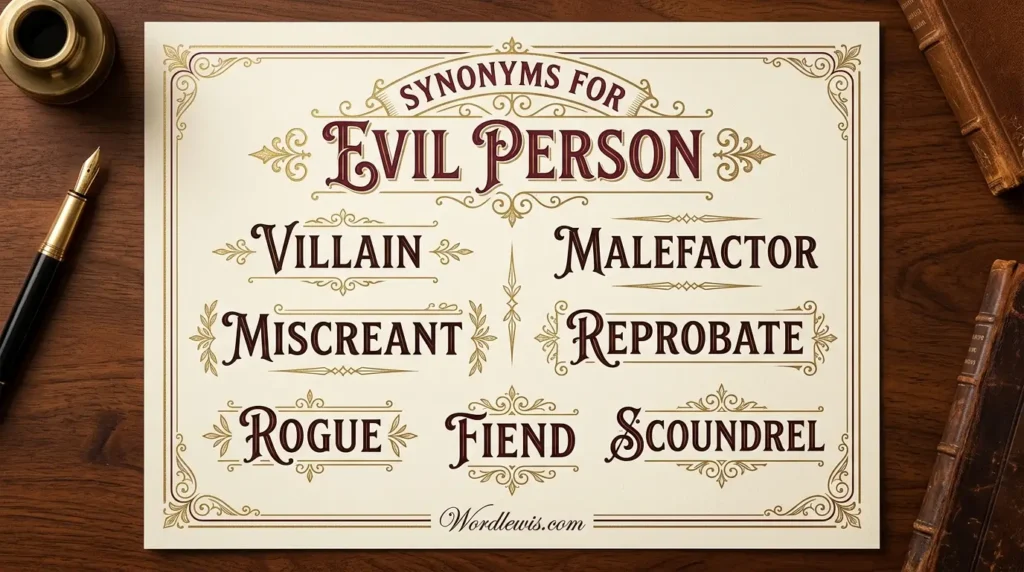
An evil person is someone who chooses to do things that hurt others or cause harm. For example, imagine a person who lies to a friend, steals their money, and feels no guilt.
You might call that person evil, cruel, or wicked. The phrase “evil person” is often used in stories, books, films, and daily talks to describe someone who does bad things.
Learning synonyms for evil person can help you express ideas in a clear and powerful way.
English learners can use these words to build their vocabulary, while content writers can make their work more interesting and avoid using the same word too often.
However, not every synonym has the same meaning or strength. Some words describe cruelty, while others suggest dishonesty or a desire to harm.
This guide explains the meaning, history, pronunciation, grammar, and 30 useful synonyms for evil person, with simple examples.
Meaning of Evil Person
Definition
Evil person (Noun Phrase): A person who does very bad things or has a strong desire to harm others.
Examples
- The evil person hurt many people to gain power.
- Everyone feared the evil person who lived in the old castle.
Connotative Meaning
(Connotation: the feelings or ideas that a word brings to mind beyond its basic meaning.)
- Positive tone: The phrase has no usual positive meaning. In fiction, an evil character may be admired for being clever or powerful, but the word evil remains negative.
- Negative tone: It suggests cruelty, harm, wickedness, or a lack of concern for others.
- Neutral tone: It can be used as a descriptive label in a story or discussion, but it still carries a strong negative meaning.
Etymology
The phrase evil person combines two words with different histories.
- Old English (450–1100): Evil comes from Old English yfel, meaning bad, wicked, or harmful. Person comes from Latin persona, meaning a role or character, through later language forms.
- Middle English (1100–1500): The word evil appeared in forms such as evil and ivel. The word person entered English through Anglo-French and Old French forms.
- Modern English (1500–Present): Both words developed into their familiar modern forms. The phrase evil person is now used to describe someone seen as deeply wicked or harmful.
Pronunciation (IPA)
- IPA: /ˈiːvəl ˈpɜːsən/ (British English); /ˈiːvəl ˈpɝːsən/ (American English)
- Syllables: evil person — ev-il per-son (4 syllables in total)
Affixation Pattern of Evil Person
- Root: Evil and person are the two main words in the phrase.
- Prefix: There is no prefix in evil person.
- Suffix: The word person ends in -on, but this is not a productive suffix added to evil to form the phrase.
- Word formations:
- Evil (adjective): morally bad or harmful.
- Evilly (adverb): in an evil or wicked way.
- Evilness (noun): the quality of being evil.
- Person (noun): a human being.
- Personal (adjective): relating to an individual.
- Personally (adverb): in an individual or private way.
- Personhood (noun): the state of being a person.
- Personify (verb): to represent a quality or idea as a person.
- Personification (noun): the act or result of personifying something.
- Impersonal (adjective): not connected with an individual or personal feelings.
30 Synonyms of Evil Person With Meaning & Examples
1. Villain (Noun)
Meaning: A person who does harmful or wicked things, especially in a story.
Examples:
- The villain tried to destroy the peaceful town.
- The hero finally defeated the villain.
2. Evildoer (Noun)
Meaning: A person who does evil or morally wrong acts.
Examples:
- The evildoer stole money from innocent people.
- The story follows an evildoer who seeks power.
3. Villainess (Noun)
Meaning: A female villain who acts in a cruel or harmful way.
Examples:
- The villainess tricked the king.
- The film features a clever villainess.
4. Fiend (Noun)
Meaning: A very cruel or wicked person.
Examples:
- The cruel fiend showed no mercy.
- People feared the fiend who harmed travelers.
5. Monster (Noun)
Meaning: A person who behaves in an extremely cruel or inhuman way.
Examples:
- He called the man a monster after learning what he had done.
- The monster in the story frightened the whole village.
6. Brute (Noun)
Meaning: A person who uses force and shows little care for others.
Examples:
- The brute pushed the helpless man.
- Everyone avoided the brute because he often started fights.
7. Tyrant (Noun)
Meaning: A cruel ruler who uses power unfairly.
Examples:
- The tyrant punished anyone who questioned him.
- The people worked together to remove the tyrant.
8. Despot (Noun)
Meaning: A ruler who has great power and uses it harshly.
Examples:
- The despot refused to listen to his people.
- The nation suffered under a cruel despot.
9. Sadist (Noun)
Meaning: A person who takes pleasure in causing pain or suffering.
Examples:
- The story’s sadist enjoyed making others afraid.
- The cruel guard acted like a sadist.
10. Psychopath (Noun)
Meaning: An informal term often used for a person who shows severe antisocial traits and little remorse.
Examples:
- The crime novel presents the killer as a psychopath.
- The detective believed the criminal showed psychopathic traits.
11. Sociopath (Noun)
Meaning: An informal term for a person who shows persistent antisocial behavior and little concern for others.
Examples:
- The fictional sociopath lied to everyone around him.
- The writer created a sociopath who cared only about himself.
12. Criminal (Noun)
Meaning: A person who commits a crime.
Examples:
- The criminal broke into the shop at night.
- The police searched for the criminal.
13. Culprit (Noun)
Meaning: A person responsible for a wrong act or offense.
Examples:
- The culprit had damaged the school gate.
- The detective found the culprit behind the theft.
14. Wrongdoer (Noun)
Meaning: A person who does something morally or legally wrong.
Examples:
- The wrongdoer had to face the results of his actions.
- The judge asked the wrongdoer to tell the truth.
15. Malefactor (Noun)
Meaning: A person who commits a harmful or criminal act.
Examples:
- The guards caught the malefactor near the palace.
- The old tale describes a malefactor who robbed travelers.
16. Miscreant (Noun)
Meaning: A person who behaves badly or breaks rules.
Examples:
- The miscreant damaged public property.
- The villagers wanted the miscreant to stop causing trouble.
17. Scoundrel (Noun)
Meaning: A dishonest person who treats others badly.
Examples:
- The scoundrel tricked the farmer out of his savings.
- She refused to trust the scoundrel again.
18. Rogue (Noun)
Meaning: A dishonest or unprincipled person who often breaks rules.
Examples:
- The rogue sold fake goods to customers.
- The story follows a rogue who cheats wealthy travelers.
19. Knave (Noun)
Meaning: A dishonest or untrustworthy person.
Examples:
- The king called the lying servant a knave.
- The knave made promises he never planned to keep.
20. Rascal (Noun)
Meaning: A person who behaves badly or causes trouble; the word can also be playful.
Examples:
- The little rascal hid his brother’s shoes.
- Everyone knew the rascal had played a trick on them.
21. Cheat (Noun)
Meaning: A person who acts dishonestly to gain an unfair advantage.
Examples:
- The cheat lied about the test results.
- Nobody wanted to work with the cheat.
22. Swindler (Noun)
Meaning: A person who tricks others out of money or property.
Examples:
- The swindler promised people a fake reward.
- The police caught the swindler after many complaints.
23. Fraudster (Noun)
Meaning: A person who uses lies or deception to commit fraud.
Examples:
- The fraudster stole money through fake messages.
- The fraudster was arrested for deceiving customers.
24. Deceiver (Noun)
Meaning: A person who misleads others through lies or tricks.
Examples:
- The deceiver hid the truth from his friends.
- She learned that the deceiver had made up the story.
25. Traitor (Noun)
Meaning: A person who betrays a country, group, or person they should support.
Examples:
- The traitor gave secret plans to the enemy.
- His friends felt hurt when they discovered the traitor’s actions.
26. Betrayer (Noun)
Meaning: A person who breaks someone’s trust or loyalty.
Examples:
- The betrayer shared her private secret.
- He could not forgive the betrayer for lying to him.
27. Oppressor (Noun)
Meaning: A person or group that treats others unfairly and keeps them under control.
Examples:
- The oppressor took away the villagers’ rights.
- The people stood together against their oppressor.
28. Persecutor (Noun)
Meaning: A person who repeatedly harms or treats another person unfairly because of their identity, beliefs, or group.
Examples:
- The persecutor punished people for their beliefs.
- The story tells how the victims escaped their persecutor.
29. Tormentor (Noun)
Meaning: A person who causes someone repeated pain, fear, or distress.
Examples:
- The bully became a tormentor to the younger children.
- The victim finally spoke out against her tormentor.
30. Sadistic Person (Noun Phrase)
Meaning: A person who enjoys causing pain or suffering to others.
Examples:
- The sadistic person laughed when others felt afraid.
- The novel’s sadistic person hurt people to feel powerful.
Prototype Meaning
The typical meaning of evil person is someone who knowingly chooses to do serious harm and shows little concern for the pain they cause.
When people hear this phrase, they may imagine a cruel villain, a dishonest leader, or someone who hurts innocent people for personal gain.
In stories, an evil person often lies, abuses power, betrays others, or acts without remorse.
However, the phrase is a strong judgment, so it should be used with care when talking about real people.
A more precise word, such as cheat, tyrant, or tormentor, may describe the person’s actions more clearly.
Prototype Categorization
The 30 synonyms can be grouped by their main meanings. This helps writers choose a word that matches the person’s actions rather than using evil person for every situation.
- General wickedness: Villain, evildoer, fiend, monster. These words suggest serious cruelty or evil behavior.
- Cruelty and force: Brute, sadist, sadistic person, tormentor. Use these when a person causes pain, fear, or suffering.
- Abuse of power: Tyrant, despot, oppressor, persecutor. These words fit people who use authority to control or harm others.
- Crime and wrongdoing: Criminal, culprit, wrongdoer, malefactor, miscreant. These words focus on harmful, illegal, or rule-breaking actions.
- Dishonesty and deception: Scoundrel, rogue, knave, cheat, swindler, fraudster, deceiver. These describe people who lie, cheat, or trick others.
- Betrayal and disloyalty: Traitor, betrayer. Use these when someone breaks trust or turns against a person or group.
- Antisocial traits in descriptions or fiction: Psychopath, sociopath. These terms are often used in fictional writing and casual speech, but they should not be used as casual diagnoses of real people.
- Female villain: Villainess. This word specifically describes a female villain.
- Playful or milder misbehavior: Rascal. This word can describe a naughty person without suggesting serious evil.
These categories help writers select words with the right tone.
For example, fraudster fits a person who steals through deception, while tyrant fits a cruel ruler. Choosing a precise synonym makes writing clearer and more natural.
Antonyms of Evil Person
- Good person (Noun Phrase): Someone who treats others with kindness and respect.
- Saint (Noun): A person known for great goodness or moral virtue.
- Benefactor (Noun): Someone who helps another person, often by giving money or support.
- Altruist (Noun): A person who cares about others and acts to help them.
- Humanitarian (Noun): Someone who works to improve people’s lives and reduce suffering.
- Philanthropist (Noun): A person who gives money, time, or resources to help others.
- Peacemaker (Noun): A person who helps settle arguments and bring people together.
- Protector (Noun): Someone who keeps others safe from harm.
- Good Samaritan (Noun Phrase): A person who helps someone in need.
- Hero (Noun): A person admired for brave or helpful actions.
Short Questions and Answers
What does evil person mean?
An evil person is someone who does very bad things or deliberately harms others.
When should evil person be used?
Use this phrase when you want to describe someone as deeply wicked or harmful.
For more precise writing, choose a word that explains the person’s actions, such as fraudster or oppressor.
Is evil person positive or negative?
It is negative. It suggests that a person is morally bad, cruel, or harmful.
How is it different from similar words?
Evil person is a broad phrase.
Villain often fits stories, tyrant describes a cruel ruler, swindler describes someone who cheats people for money, and tormentor describes someone who causes repeated suffering.
Conclusion
Learning synonyms for evil person helps you express ideas with greater care and skill.
Words such as villain, fiend, scoundrel, and oppressor describe different kinds of harmful behavior.
Using the right word can make your writing clearer and more powerful. It can also help you speak with confidence and explain a person’s actions without repeating the same phrase.
English learners can build their vocabulary by learning a few new words each day and using them in simple sentences.
Content writers can also use these words to make stories, essays, and articles more engaging.
Remember that some synonyms are stronger than others, and a few have special meanings. Practice often, read widely, and choose each word based on its meaning and context.

welcome to Words Mints! I’m Halay Sultan, a web developer and AI-Powered SEO content writer.