
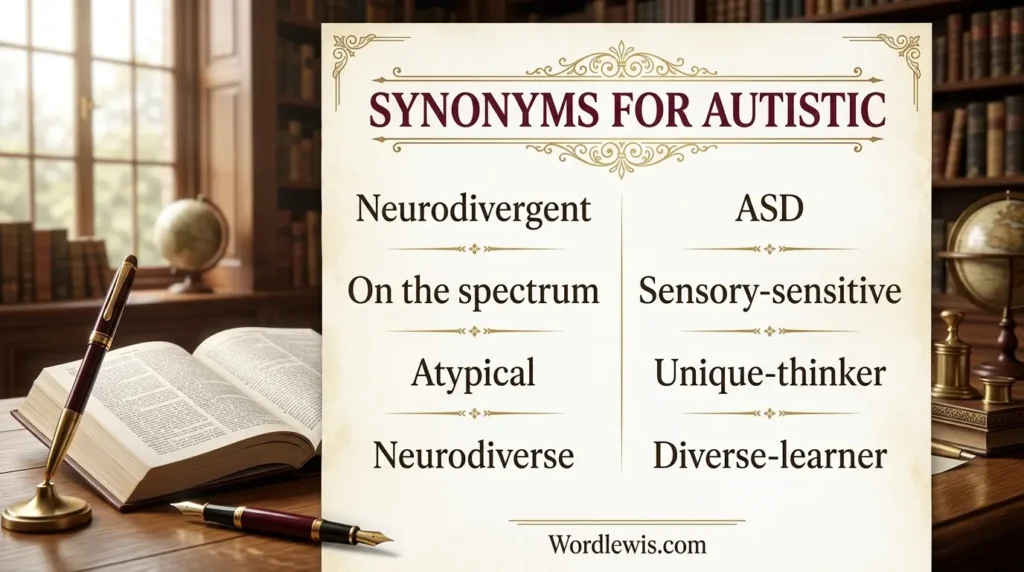
Autistic is an adjective used to describe a person who is autistic or has autism.
For example, a teacher may say that an autistic student learns best with clear instructions, a quiet space, or a steady routine. The word is common in schools, workplaces, health care, and daily life.
Learning synonyms can help English learners and content writers explain ideas in clear and respectful ways.
However, autistic does not have 30 exact synonyms. Autism is a form of neurodivergence, and each person may describe their identity in a different way.
Some alternatives describe autism, while others refer to specific traits or support needs. These terms are not always interchangeable.
This guide explains the meaning of autistic, its history, pronunciation, word forms, and related terms.
It also provides examples and semantic categories to help you choose language that fits each situation while respecting autistic people.
Meaning of Autistic
Definition
Autistic (Adjective): Describes a person who is autistic or relates to autism, a lifelong neurodevelopmental condition that can affect communication, social interaction, sensory processing, and patterns of behavior or interests.
Examples
- My autistic friend enjoys clear plans and quiet spaces.
- The school offers support to autistic students with different learning needs.
Connotative Meaning
(Connotation: the feelings or ideas that a word may bring to mind beyond its basic meaning.)
- Positive tone: Can express identity, pride, acceptance, and respect when used in a person’s preferred way.
- Negative tone: Can sound hurtful when used as an insult or to suggest that someone is less capable.
- Neutral tone: Can describe autism in educational, medical, personal, or everyday contexts without judging the person.
The word itself is not negative. Its tone depends on how it is used and the attitudes behind it.
Etymology
The word autistic comes from autism, which is linked to the Greek word autos, meaning “self.” The suffix -ic means “relating to” or “having the nature of.”
- Old English (450–1100): The word autistic was not part of Old English. Its Greek roots existed long before the English term developed.
- Middle English (1100–1500): The word was not in common use during this period. English had not yet adopted the modern medical term.
- Modern English (1500–Present): The term autism entered medical language in the early twentieth century, and autistic developed as its related adjective. Today, it is widely used in medical, educational, and community settings.
Pronunciation (IPA)
- IPA: /ɔːˈtɪstɪk/ (common British pronunciation); /ɔːˈtɪstɪk/ or /ɑːˈtɪstɪk/ depending on the speaker’s accent.
- Syllables: au-tis-tic (3 syllables).
Affixation Pattern of Autistic
- Root: aut- — from Greek autos, meaning “self.”
- Prefix: None in the word autistic.
- Suffix: -ic — means “relating to” or “having the nature of.”
Word Formations
- Autism (noun): A neurodevelopmental condition.
- Autistic (adjective): Relating to autism or describing an autistic person.
- Autistically (adverb): In a way associated with autism; uncommon and best used only when needed.
- Autistic person (noun phrase): A person who is autistic.
- Autistic people (plural noun phrase): More than one person who is autistic.
The phrase autistic person is not a separate word formation, but it is a common and respectful way to describe someone who prefers identity-first language.
30 Synonyms of Autistic With Meaning and Examples
The following words and phrases are related alternatives, not exact synonyms. Some describe autism directly, while others describe identity, individual traits, or support needs. Choose the term that matches the meaning you want to express.
1. On the Autism Spectrum (Descriptive Phrase)
Meaning: Describes someone whose experiences or traits are associated with autism.
Examples:
- She is on the autism spectrum.
- People on the autism spectrum have different strengths and needs.
2. Neurodivergent (Adjective)
Meaning: Describes a person whose brain processes information differently from what is considered typical.
Examples:
- He is neurodivergent and has a unique way of learning.
- The company supports neurodivergent employees.
3. Neurodiverse (Adjective)
Meaning: Describes a group that includes people with different ways of thinking and processing information; neurodivergent is usually more suitable for an individual.
Examples:
- The classroom has a neurodiverse group of learners.
- A neurodiverse team may bring many different viewpoints.
4. Neuroatypical (Adjective)
Meaning: Describes a person whose brain development or functioning differs from what is considered typical.
Examples:
- The program welcomes neuroatypical learners.
- Neuroatypical people may have different learning preferences.
5. Autistic Individual (Noun Phrase)
Meaning: A person who is autistic.
Examples:
- The autistic individual shared her experiences.
- Each autistic individual has different preferences.
6. Autistic Person (Noun Phrase)
Meaning: A person who identifies as autistic or is described as autistic.
Examples:
- The autistic person asked for written instructions.
- We should listen to each autistic person’s needs.
7. Person With Autism (Noun Phrase)
Meaning: A person who has autism; some people prefer this person-first expression.
Examples:
- The event welcomes every person with autism.
- The support group helps people with autism connect.
8. Person on the Autism Spectrum (Noun Phrase)
Meaning: A person whose neurodevelopment falls within the autism spectrum.
Examples:
- The person on the autism spectrum requested a quiet room.
- Every person on the autism spectrum has individual experiences.
9. Autistic Adult (Noun Phrase)
Meaning: An adult who is autistic.
Examples:
- The autistic adult spoke about workplace access.
- The course helps autistic adults build career skills.
10. Autistic Child (Noun Phrase)
Meaning: A child who is autistic.
Examples:
- The autistic child enjoys drawing.
- The teacher gives the autistic child clear instructions.
11. Autistic Student (Noun Phrase)
Meaning: A student who is autistic.
Examples:
- The autistic student benefits from a clear schedule.
- The school provides tools for autistic students.
12. Autistic Learner (Noun Phrase)
Meaning: A person who is autistic and is learning a skill or subject.
Examples:
- The autistic learner prefers visual instructions.
- Teachers can adapt lessons for autistic learners.
13. Autistic Employee (Noun Phrase)
Meaning: A worker who is autistic.
Examples:
- The autistic employee asked for fewer distractions.
- The manager listens to the autistic employee’s needs.
14. Autistic Advocate (Noun Phrase)
Meaning: An autistic person who speaks up for rights, access, or inclusion.
Examples:
- The autistic advocate spoke at the meeting.
- An autistic advocate shared ideas for better public services.
15. Autistic Community Member (Noun Phrase)
Meaning: A person who is autistic and belongs to an autistic community.
Examples:
- The autistic community member helped plan the event.
- Each autistic community member brought a different perspective.
16. Neurodevelopmentally Different (Adjective Phrase)
Meaning: Describes a person whose brain development differs from typical development.
Examples:
- The program supports neurodevelopmentally different learners.
- Neurodevelopmentally different people may need different forms of support.
17. Sensory-Sensitive (Adjective)
Meaning: Describes someone who is especially affected by sights, sounds, textures, smells, or other sensory input.
Examples:
- The sensory-sensitive student wore ear defenders.
- A sensory-sensitive person may prefer soft lighting.
Note: Sensory sensitivity is not unique to autism.
18. Sensory-Seeking (Adjective)
Meaning: Describes someone who actively seeks certain sensory experiences.
Examples:
- The sensory-seeking child enjoyed swinging.
- Some sensory-seeking people like movement and textured objects.
Note: This describes a possible sensory trait, not a synonym for autism.
19. Sensory-Avoidant (Adjective)
Meaning: Describes someone who avoids sensory experiences that feel uncomfortable or overwhelming.
Examples:
- The sensory-avoidant student chose a quiet lunch area.
- A sensory-avoidant person may avoid crowded spaces.
20. Routine-Oriented (Adjective)
Meaning: Describes someone who prefers regular routines and predictable plans.
Examples:
- The routine-oriented student likes a daily timetable.
- A routine-oriented person may feel more comfortable with advance notice.
21. Detail-Oriented (Adjective)
Meaning: Describes someone who pays close attention to small details.
Examples:
- The detail-oriented designer noticed a small error.
- Her detail-oriented approach improved the report.
22. Pattern-Oriented (Adjective)
Meaning: Describes someone who pays attention to patterns, repeated forms, or connections.
Examples:
- The pattern-oriented learner enjoyed the puzzle.
- He used his pattern-oriented thinking to solve the problem.
23. Literal-Minded (Adjective)
Meaning: Describes someone who tends to interpret words according to their direct meaning rather than implied meanings.
Examples:
- The literal-minded reader asked what the phrase meant.
- Clear wording can help a literal-minded person understand instructions.
Note: Literal interpretation varies among autistic people and is not exclusive to autism.
24. Socially Different (Adjective Phrase)
Meaning: Describes someone whose way of interacting socially differs from common expectations.
Examples:
- The speaker described her socially different communication style.
- People may have socially different ways of making friends.
Note: This is broad and should not be used to label someone without a reason.
25. Differently Communicating (Adjective Phrase)
Meaning: Describes someone who communicates in a way that differs from common speech or social conventions.
Examples:
- The event welcomes differently communicating participants.
- Some people communicate through writing, gestures, or speech devices.
26. Nonspeaking (Adjective)
Meaning: Describes a person who does not use spoken language to communicate, either consistently or in a particular context.
Examples:
- The nonspeaking student used a communication device.
- Nonspeaking people may communicate through typing or gestures.
Note: Not all autistic people are nonspeaking, and nonspeaking does not mean unable to understand.
27. Minimally Speaking (Adjective Phrase)
Meaning: Describes someone who uses little spoken language.
Examples:
- The minimally speaking child communicated with picture cards.
- The team offered communication tools for minimally speaking participants.
Note: This term describes speech use, not autism itself.
28. Communication-Different (Adjective)
Meaning: Describes someone whose communication style differs from common expectations.
Examples:
- The communication-different student preferred written questions.
- Inclusive teams respect communication-different colleagues.
Note: This is a descriptive phrase, not a formal diagnostic term.
29. Support-Needing (Adjective Phrase)
Meaning: Describes someone who needs support in a particular area or situation.
Examples:
- The student needing support received extra classroom help.
- Support needs can change with the setting and task.
Note: It is clearer to name the actual support needed than to use this broad label.
30. Neurodivergent Person (Noun Phrase)
Meaning: A person whose brain functions or processes information in ways that differ from typical expectations.
Examples:
- The neurodivergent person requested flexible work hours.
- The group welcomes neurodivergent people with different experiences.
Note: Neurodivergence includes conditions and differences beyond autism, so this phrase is broader than autistic.
Prototype Meaning
The most typical meaning of autistic is a person who has autism as part of their lifelong neurodevelopment.
When people hear this word, they may think of differences in communication, social interaction, sensory experiences, routines, or interests.
However, autism is a spectrum, and no single trait describes every autistic person.
Some autistic people need substantial daily support, while others live independently. Many have distinct strengths, interests, and ways of understanding the world.
The word should describe a person or a relevant characteristic, not be used to judge someone’s intelligence, worth, or ability.
Prototype Categorization
The 30 related terms can be grouped by their meaning and use. This helps writers choose words that match the person, trait, or situation they want to describe.
- Direct autism-related terms: On the autism spectrum, autistic individual, autistic person, person with autism, person on the autism spectrum. Use these when referring directly to autism.
- Age and role terms: Autistic adult, autistic child, autistic student, autistic learner, autistic employee, autistic advocate, autistic community member. These add useful information about a person’s age, role, or community involvement.
- Broader neurodiversity terms: Neurodivergent, neurodiverse, neuroatypical, neurodevelopmentally different, neurodivergent person. These describe broader differences and are not all specific to autism.
- Sensory-related terms: Sensory-sensitive, sensory-seeking, sensory-avoidant. Use these when discussing a specific sensory experience or preference.
- Thinking and routine terms: Routine-oriented, detail-oriented, pattern-oriented, literal-minded. These describe possible traits, not all autistic people.
- Communication-related terms: Socially different, differently communicating, nonspeaking, minimally speaking, communication-different. Use these only when they accurately describe someone’s communication.
- Support-related terms: Support-needing. When possible, state the specific support a person needs instead.
These categories help content writers avoid repetition and choose precise words. Most importantly, they prevent a specific trait from being mistaken for a definition of autism.
Antonyms of Autistic
There is no exact antonym for autistic. Autism is a form of neurodevelopment, not a quality that has a simple opposite.
However, the following terms may be useful when discussing differences in a specific context.
1. Neurotypical (Adjective)
Meaning: Describes a person whose neurodevelopment and functioning fit common expectations.
– Example: The neurotypical student preferred the usual classroom routine.
2. Non-autistic (Adjective)
Meaning: Describes a person who is not autistic.
– Example: The group included autistic and non-autistic participants.
3. Typical (Adjective)
Meaning: Describes something that is common or expected in a particular group or setting.
– Example: The teacher explained the typical classroom schedule.
4. Conventional (Adjective)
Meaning: Describes something that follows common customs or accepted practices.
– Example: The team used a conventional approach to the task.
5. Standard (Adjective)
Meaning: Describes something that follows a usual or accepted pattern.
– Example: The school offered a standard lesson plan.
Important: These terms are not interchangeable. Non-autistic directly contrasts with autistic, while neurotypical refers to a broader pattern of neurodevelopment.
Neither word implies that one person is better than another.
Short Questions and Answers
What does autistic mean?
Autistic describes a person who is autistic or something related to autism, a lifelong neurodevelopmental condition that can affect communication, sensory processing, and behavior.
When should autistic be used?
Use autistic when discussing autism accurately and respectfully. If you are describing a particular trait, such as sensory sensitivity, use that specific term when it fits.
Is autistic positive or negative?
The word is neutral. It can express identity and pride, but it can sound hurtful when used as an insult. Respect the language each person prefers.
How is it different from similar words?
Autistic specifically relates to autism. Neurodivergent covers a broader range of neurological differences.
Neurotypical describes someone whose neurodevelopment fits common expectations, while sensory-sensitive describes a particular trait rather than a diagnosis.
Conclusion
Learning the meaning of autistic and its related terms can improve your vocabulary and help you communicate with care.
These words can make your writing clearer, strengthen your speaking skills, and reduce repetition. However, choosing the right term matters more than using many alternatives.
Some words describe autism directly, while others refer to sensory traits, communication styles, or broader neurological differences.
For English learners and content writers, understanding these distinctions builds confidence and helps prevent common language mistakes.
Practice using new words in simple sentences each day. Read how autistic people describe themselves, respect their preferred language, and choose words that fit the context.
Clear, respectful language helps readers understand autism without reducing people to a label.

welcome to Words Mints! I’m Halay Sultan, a web developer and AI-Powered SEO content writer.