
Introduction
A turtle is a slow-moving reptile with a hard shell that protects its body. Imagine seeing a small turtle crossing a garden path after rain.
It moves slowly, but its strong shell keeps it safe. The word turtle is common because it names a familiar animal found in ponds, rivers, oceans, and on land.
Learning synonyms and related words helps English learners describe animals more clearly and helps content writers avoid using the same word again and again.
In this guide, we will explore the meaning of turtle, its closest synonyms and related terms, examples, grammar, history, pronunciation, and word formation.
We will also look at different semantic categories so you can choose the right word for different types of turtles and different writing situations.
Meaning of Turtle
Definition
Turtle (Noun): A reptile with a hard shell that protects its body and that may live on land, in freshwater, or in the sea.
Examples
- The turtle slowly walked toward the pond
- We saw a sea turtle swimming near the beach
Connotative Meaning
Connotation: The feelings or ideas that a word suggests beyond its basic meaning
- Positive tone: Turtle can suggest patience, safety, calmness, and endurance
- Negative tone: In some contexts, turtle can suggest slowness or lack of speed
- Neutral tone: It can simply describe the animal without any emotional meaning
Etymology
The word turtle has a long history connected with words for tortoises and turtles
- Old English (450–1100): The modern word does not come directly from a common Old English form; older English used terms such as tortuse for tortoise-like animals
- Middle English (1100–1500): Forms such as turtle and tortle appeared, influenced by Old French and Latin terms related to tortoises
- Modern English (1500–Present): Turtle became an established general English word for shelled reptiles, with usage later developing differently in British and American English
Pronunciation (IPA)
- IPA: /ˈtɜːrtəl/ in many British and American pronunciations, with American pronunciation commonly represented as /ˈtɝːtəl/
- Syllables: tur-tle
Affixation Pattern of Turtle
- Root: turtle
- Prefix: None
- Suffix: None in the basic word
- Word formations:
- turtle — noun
- turtles — plural noun or third-person singular verb
- turtled — past-tense verb in rare or specialized usage
- turtling — present participle or gerund in specialized usage
- turtlelike — adjective meaning similar to a turtle
- turtle-shaped — adjective describing something shaped like a turtle
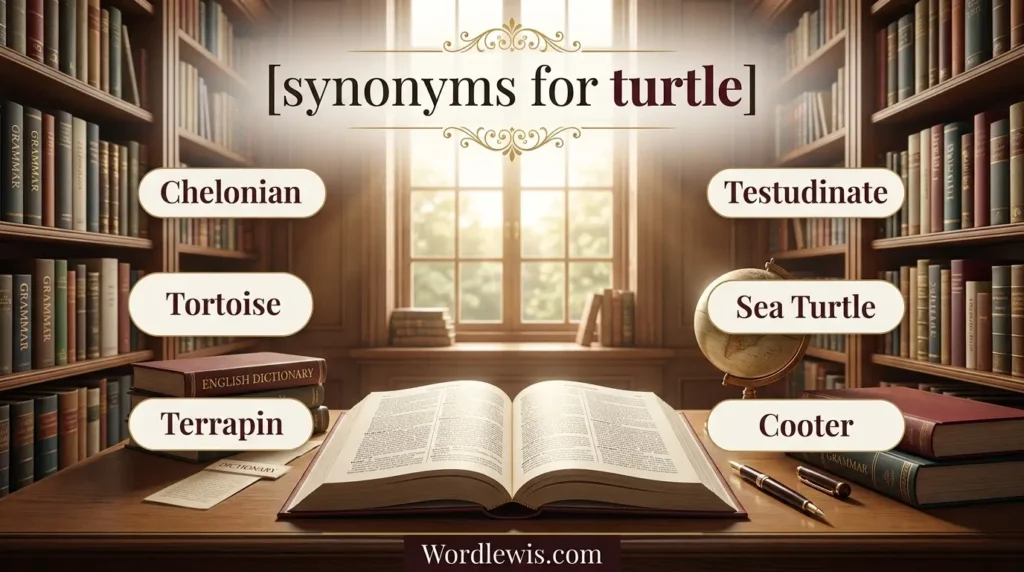
30 Synonyms of Turtle With Meaning & Examples
Note: English does not have 30 exact synonyms for turtle. The list below includes the closest synonyms, species terms, regional terms, and closely related names used to describe turtles. This distinction helps writers avoid using an inaccurate word.
1. Tortoise (Noun)
Meaning: A shelled reptile that usually lives on land
Examples:
- The tortoise moved slowly across the grass
- The zookeeper cared for a large tortoise
2. Terrapin (Noun)
Meaning: A term often used for certain freshwater or brackish-water turtles
Examples:
- The terrapin rested on a fallen branch
- We watched a terrapin near the marsh
3. Sea Turtle (Noun)
Meaning: A turtle adapted to living mainly in the ocean
Examples:
- The sea turtle returned to the beach
- A sea turtle swam through the clear water
4. Freshwater Turtle (Noun)
Meaning: A turtle that lives mainly in freshwater habitats
Examples:
- The freshwater turtle climbed onto a log
- We spotted a freshwater turtle in the lake
5. Land Turtle (Noun)
Meaning: A turtle or turtle-like reptile that lives mainly on land
Examples:
- The land turtle searched for food
- A land turtle crossed the forest floor
6. Box Turtle (Noun)
Meaning: A land turtle known for its hinged shell that helps it close tightly
Examples:
- The box turtle pulled its head inside its shell
- We found a box turtle under a bush
7. Snapping Turtle (Noun)
Meaning: A freshwater turtle known for its strong jaws and defensive behavior
Examples:
- The snapping turtle stayed near the muddy bank
- A snapping turtle can defend itself with a powerful bite
8. Painted Turtle (Noun)
Meaning: A freshwater turtle known for its colorful markings
Examples:
- The painted turtle rested on a log
- A painted turtle was swimming near the reeds
9. Green Turtle (Noun)
Meaning: A large sea turtle with a greenish color in parts of its body
Examples:
- The green turtle moved through the warm sea
- Researchers observed a green turtle near the reef
10. Loggerhead (Noun)
Meaning: A large sea turtle recognized by its large head and strong jaws
Examples:
- The loggerhead surfaced beside the boat
- A loggerhead returned to the nesting beach
11. Leatherback (Noun)
Meaning: The largest living sea turtle, known for its leathery shell
Examples:
- The leatherback traveled across a large stretch of ocean
- Scientists tracked a leatherback during migration
12. Hawksbill (Noun)
Meaning: A sea turtle with a narrow head and a curved, hawk-like beak
Examples:
- The hawksbill moved around the coral reef
- A hawksbill was seen near the tropical island
13. Ridley (Noun)
Meaning: A name used for small sea turtles, especially olive ridleys and Kemp’s ridleys
Examples:
- The ridley turtle came ashore to nest
- Scientists studied the nesting behavior of the ridley
14. Musk Turtle (Noun)
Meaning: A small freshwater turtle belonging to the musk turtle group
Examples:
- The musk turtle hid among aquatic plants
- We saw a musk turtle in the shallow water
15. Mud Turtle (Noun)
Meaning: A small freshwater turtle commonly associated with muddy habitats
Examples:
- The mud turtle disappeared into the shallow water
- A mud turtle rested beneath the leaves
16. Snapping Reptile (Noun)
Meaning: A descriptive term for a turtle known for snapping or biting defensively
Examples:
- The snapping reptile stayed close to the riverbank
- The guide warned us not to touch the snapping reptile
17. Shelled Reptile (Noun)
Meaning: A reptile with a protective shell, including turtles and tortoises
Examples:
- The shelled reptile moved slowly across the path
- We learned about this shelled reptile at the nature center
18. Chelonian (Noun)
Meaning: A scientific term for a member of the turtle and tortoise group
Examples:
- The researcher studied a rare chelonian
- The museum displayed fossils of ancient chelonians
19. Testudine (Noun)
Meaning: A scientific or formal term referring to a turtle or tortoise
Examples:
- The scientist recorded the testudine’s behavior
- The fossil belonged to an ancient testudine
20. Testudinean (Noun)
Meaning: A member of the turtle and tortoise group
Examples:
- The researcher identified the animal as a testudinean
- Several testudineans were studied in the project
21. Reptile (Noun)
Meaning: A cold-blooded vertebrate animal with scales or related protective coverings
Examples:
- A turtle is a type of reptile
- The reptile moved toward the water
22. Aquatic Reptile (Noun)
Meaning: A reptile that spends much of its life in water
Examples:
- The turtle is an aquatic reptile
- The aquatic reptile surfaced for air
23. Marine Reptile (Noun)
Meaning: A reptile that lives in marine environments
Examples:
- The sea turtle is a marine reptile
- The marine reptile traveled through deep water
24. Freshwater Reptile (Noun)
Meaning: A reptile that lives mainly in freshwater habitats
Examples:
- The turtle is a freshwater reptile
- The freshwater reptile rested beside the lake
25. Shelled Animal (Noun)
Meaning: An animal that has a protective shell covering part of its body
Examples:
- The turtle is a well-known shelled animal
- The child drew a picture of a shelled animal
26. Pond Turtle (Noun)
Meaning: A turtle commonly found in or around ponds
Examples:
- The pond turtle climbed onto a rock
- We saw a pond turtle near the reeds
27. River Turtle (Noun)
Meaning: A turtle that lives in or around rivers
Examples:
- The river turtle rested beside the stream
- A river turtle disappeared beneath the water
28. Water Turtle (Noun)
Meaning: A general term for a turtle that spends much of its time in water
Examples:
- The water turtle swam across the pond
- We watched a water turtle from the shore
29. Slow Mover (Noun)
Meaning: A descriptive expression for an animal that moves slowly
Examples:
- The turtle is a famous slow mover
- The little slow mover crossed the path safely
30. Shelled Reptilian (Noun)
Meaning: A descriptive term for a reptile with a protective shell
Examples:
- The shelled reptilian animal moved toward the water
- The documentary showed a large shelled reptilian creature
Prototype Meaning
The prototype meaning of turtle is a reptile with a hard protective shell, four legs or flippers, and slow movement.
When people hear the word turtle, they usually imagine a small or medium-sized shelled animal moving slowly on land or swimming in water.
The exact image can change depending on the context because turtles include many different species.
Prototype Categorization
The 30 terms can be grouped into useful semantic categories:
- General terms: turtle, tortoise, terrapin, reptile, chelonian, testudine, and testudinean are useful when discussing turtles broadly or scientifically
- Habitat terms: sea turtle, freshwater turtle, land turtle, pond turtle, river turtle, water turtle, aquatic reptile, marine reptile, and freshwater reptile identify where the animal lives
- Species and group names: box turtle, snapping turtle, painted turtle, green turtle, loggerhead, leatherback, hawksbill, ridley, musk turtle, and mud turtle are more specific
- Descriptive terms: shelled reptile, shelled animal, shelled reptilian, and slow mover describe important features rather than naming a particular species
This categorization helps writers choose words based on meaning.
A scientific article may use chelonian, while a nature story may use sea turtle or a specific species name. A simple learner’s text can usually stay with turtle.
Antonyms of Turtle
There is no direct antonym for turtle because it is an animal name rather than a quality or action. However, some contrasting terms can describe opposite characteristics:
Fast Animal (Noun)
- Meaning: An animal known for moving quickly
Swift Creature (Noun)
- Meaning: A creature that moves with great speed
Runner (Noun)
- Meaning: A person or animal that moves quickly by running
Fast Mover (Noun)
- Meaning: A person or animal capable of moving quickly
Short Questions and Answers
What does turtle mean?
A turtle is a reptile with a protective shell that may live on land, in freshwater, or in the sea.
When should turtle be used?
Use turtle when you are talking about the animal in general and do not need to identify a specific species or habitat.
Is turtle positive or negative?
Turtle is neutral. It can sound positive when linked with patience or protection and negative when used to suggest slowness, depending on context.
How is it different from similar words?
Turtle is a broad common term. Tortoise usually refers to a land-dwelling shelled reptile, while terrapin can refer to certain turtles, especially freshwater or brackish-water species.
Conclusion
Learning the word turtle and its related vocabulary can improve both English understanding and word choice.
The basic word is simple, but terms such as tortoise, terrapin, sea turtle, chelonian, loggerhead, leatherback, and hawksbill give writers more precise ways to describe these animals.
Understanding the difference between general terms and specific species names also helps avoid mistakes.
For English learners, studying related words builds vocabulary and makes speaking and writing more flexible.
For content writers, it reduces repetition and makes descriptions clearer. Try using a few new turtle-related words in sentences each day.
Regular practice can strengthen vocabulary, improve communication, and build confidence in English.

welcome to Words Mints! I’m Halay Sultan, a web developer and AI-Powered SEO content writer.